Chinese Electronic Scale and Measuring Instrument Factory

Differences in Capacity and Accuracy of Household Kitchen Scales | A Guide to Weighing and Purchasing Baking Ingredients
Why Do You Need a Dedicated Digital Scale for Baking?
In the world of baking, there’s an old saying: “A 1-gram error can ruin the whole batch.” Unlike Chinese cuisine, which emphasizes “a pinch” or “to taste,” baking demands extremely strict ingredient ratios—5 grams too much flour can cause a chiffon cake to collapse, while 3 grams too little sugar can completely alter the texture of cookies. This extreme pursuit of precision makes a reliable kitchen digital scale the “absolute must-have tool” for anyone starting out in baking.
According to industry data, the global market for household digital scales reached $3.83 billion in 2025 and is projected to grow to $6.39 billion by 2034, with baking being one of the core drivers of this growth. For international buyers, cross-border sellers, and baking brands currently sourcing products, understanding the distinction between a scale’s capacity and accuracy is the first step toward selecting the right product.
Accuracy: Why 0.1g Has Become the Mainstream Standard for Baking Scales
Accuracy is the most critical parameter for digital scales, directly determining whether they are suitable for baking applications.
From a technical standpoint, digital scales use electronic sensors to measure mass, and the precision of these sensors far exceeds that of mechanical spring-based measurement. An accuracy of 0.1g means the sensor can detect a change of 0.1 grams. In baking, trace ingredients such as baking powder (typically 1–2 grams), salt (1–3 grams), and yeast (3–5 grams) can only be accurately displayed with 0.1g precision; scales with 1g precision can only display “rounded” whole numbers, resulting in weighing errors as high as 10%–50% for these trace ingredients.
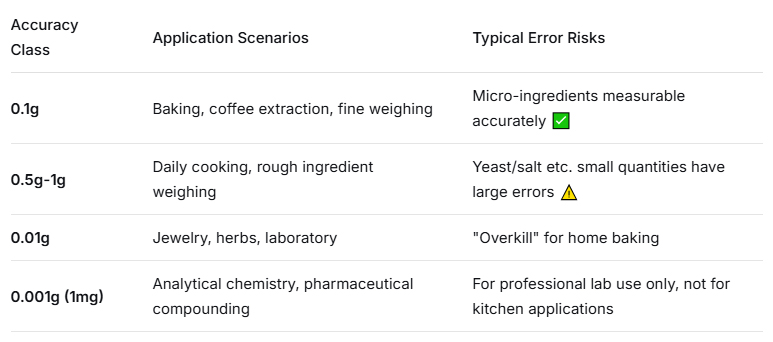
The success rate of baking using electronic scales with 0.1g accuracy is significantly higher than that of products with 1g accuracy, which is closely related to the use of MEMS (Micro-Electro-Mechanical Systems) sensors—the sensitivity of the sensors in 0.1g-accuracy scales is 10 times that of traditional 1g-accuracy strain gauge sensors.
Professional-grade baking scales may also feature “Baker’s Math” (which automatically scales recipes by percentage), an integrated timer, and memory storage functions to help users maintain recipe consistency when baking in batches.
Weighing Capacities: What Scenarios Are Best Suited for 1 kg, 3 kg, 5 kg, and 10 kg?
The weighing capacity determines the maximum weight that can be measured in a single weighing session. Choosing a capacity that’s too small requires multiple weighings, which is cumbersome, while choosing one that’s too large may reduce accuracy—on some scales, the minimum division value increases at higher capacities.
3 kg capacity: A common specification for small-to-medium-sized scales. With a compact design, it’s ideal for households with limited kitchen counter space and those who primarily bake in small batches. It easily handles a recipe requiring 450 grams of flour, 200 grams of sugar, and 100 grams of butter in a single weighing.
5 kg capacity: The mainstream choice for baking. It can accommodate larger mixing bowls in a single weighing session, making it more user-friendly for those baking bread (about 450–500 grams per loaf) or large cakes. Tests by the globally recognized authority Good Housekeeping also show that a 5 kg capacity is sufficient to cover the daily weighing needs of the vast majority of home bakers.
10 kg capacity: A high-capacity professional model. Its key selling point is the ability to “weigh the dough bowl along with the ingredients,” making it suitable for large families or users who frequently host guests; however, the unit is typically larger and heavier.
According to market research, over 70% of household users’ single weighings fall within the 0.2–5 kg range, so the 5 kg capacity is considered the “golden balance point” for home baking scales.
Materials and Features: Bonus Factors When Purchasing
The material of the weighing surface directly affects how easy it is to clean and its durability. Since flour, sauces, and butter are frequently used in baking, water- and oil-resistant properties are particularly important.
Stainless steel weighing surface: The mainstream choice—water- and oil-resistant; flour spills wipe away easily, and it’s safe for food contact.
Tempered Glass Weighing Surface: Offers good wear resistance and is equally easy to clean, but the scale is typically heavier.
Core functional features are also key considerations when purchasing:
One-Touch Tare: Place the container on the scale, zero it, and then add ingredients directly—no need to transfer ingredients back and forth for consecutive weighings. This feature is listed as a “must-have” by many bloggers.
Unit Conversion: Supports one-touch switching between grams (g), milliliters (ml), ounces (oz), and other units, suitable for both Chinese and Western recipes
LCD/LED Backlit Display: Ensures readings are clearly visible even in dimly lit kitchens
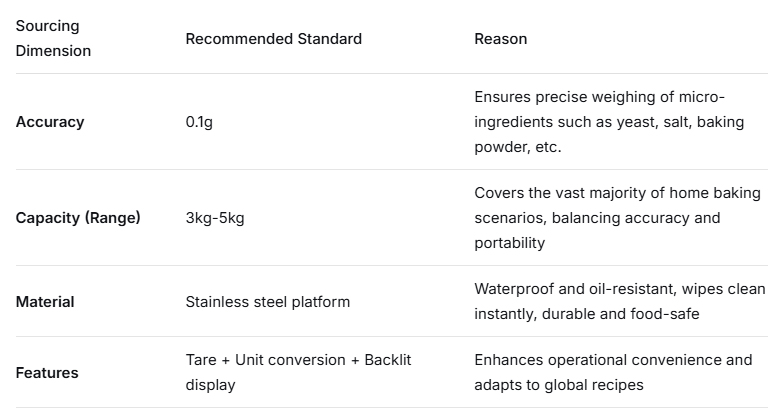
For international buyers and cross-border sellers, the combination of 0.1g accuracy and a 5kg capacity has become the “standard configuration” in the global baking market and is currently the most popular specification in cross-border e-commerce.
About Us: Shenzhen Kefeiya Technology Co., Ltd.
Shenzhen Kefeiya Technology Co., Ltd. has been deeply involved in the electronic scale and measuring instrument industry for 12 years. Located in Shenzhen, Guangdong, the company owns a 6,500-square-meter factory, employs over 200 experienced staff members, and is equipped with more than 70 large-scale production machines, with a daily production capacity of up to 10,000 electronic scales. The company maintains a complete in-house industrial chain, ranging from mold development, injection molding, and metal stamping to finished product assembly. Our entire product line has passed CE, RoHS, and FCC international certifications, ensuring compliance for export to global markets including Europe, the United States, and Southeast Asia.
We specialize in a full range of products for all scenarios, including kitchen scales, coffee scales, jewelry scales, luggage scales, measuring spoon scales, measuring cup scales, commercial pricing scales, bathroom scales, body fat scales, and measuring instruments. We offer OEM/ODM customization services, including laser-engraved logos, screen-printed logos, custom molds, and functional modifications. We maintain a massive inventory of in-stock products year-round and support both small mixed-lot orders and bulk purchases, with volume-based pricing discounts.
Kefeiya Technology sincerely welcomes global buyers, brand owners, and cross-border sellers to visit our factory for on-site inspections, where you can observe the entire production process—from injection molding and tooling to assembly and quality control—and work with us to create new opportunities in international trade.